UK & Eire Natural History Bloggers

Thursday, 30 August 2012

Acrobatic Bats, The Essex Lion and Black and Yellow Chaos.

 
As the sun sets and darkness begins fall, mysterious animals of the night wake from their slumber and begin their activities. And as I sit looking out over the garden its nocturnal wildlife I am hoping to witness. In particular bats which visit the area on a regular basis hunting the small insects around the pond at the far side of the garden. After a short wait the first one arrives a quick dart into a group of insects and then back out of sight into the darkness again. Slowly more and more arrive as they come closer to the house the lights from inside show of their brilliant acrobatics, twisting and turning in pursuit of their prey. From the size of the bats I'm confident the species tormenting the insects are Common Pipistrelle the most abundant and also the smallest bat species in the United Kingdom. After a while of being fascinated by such remarkable animals just as mysteriously as they appeared, they disappeared, leaving me to reflect on what I had just been luck enough to witness.
  
Common Pipistrelle Bat


I'm sure I am not the only one that broke a smile when the story  "The Essex Lion” broke the news recently, on reading the story for the first time my thoughts immediately went along the lines of hoax came to mind. After all there is becoming an increasingly growing trend in false alarms of big cat sightings in this country. If the story had indeed been true then obviously a very serious situation would be on the hands of a lot of people, however after seeing the picture of the "Lion" I'm extremely confident that is in no way a Lion.  Although despite the inevitable being confirmed it all be it briefly let people's imagination take over and start to wonder what if ? and that surely can be no  bad thing.


The thought of one of these magnificent animals roaming around Essex briefly caused a stir.
http://i1.dailyrecord.co.uk/incoming/article1281889.ece/ALTERNATES/s615b/Lion.jpg

I work in a very nice beach cafe with stunning views over the sea and coastline the cafe is always popular with customers and as a result is often very busy, which benefits a certain flying insect with a particular liking for sugar. As the weather warms up wasps start to emerge. Lots of them. They can be an incredible nuisance and jump on abandoned jam pots, or fizzy drink cans within seconds of the customers leaving them unattended. This then leads to a problem. Retrieving the seized goods from angry wasps in no mood to surrender their not so well earned meal. One jam pot in particular caused quite a scene one evening, after initially spotting the pot and noticing it had been claimed by two wasps I decided to leave it for a little while before coming back for another attempt. This was a mistake. A big one. By the time of my second attempt the came their number had tripled and as I tried to claim back the pot the wasps went on the offensive exposing my slightly cowardly side when coming to stinging insects I beat a hasty retreat sending a friend and work colleague bigger than myself to deal with the issue, 30 seconds later he appeared triumphantly with jam pot in hand leaving me to feel more than a little sheepish.  Everyone has an animal which they find hard to love mine is wasps in future when it comes to jam pots you can have it just don't sting me !

 Hope everyone has a good week! George


jhhjhhn pipistrelle nnnnnnhhghg


Wednesday, 15 August 2012

Congratulations in order!


Hi everyone! just a short blog this week congratulating the fine work of my fellow colleagues I have been fortunate enough to study with over the past two years.  Results day for our respective degrees revealed deserved success for a lot of hard work, dedication and commitment and everyone has every right to feel extremely proud of what they have achieved. I can also say I am the proud owner of a Wildlife Education and Media degree!  It just proved those two years of panicking about coursework deadlines and exam weeks were worth it in the end! A mention should also go to the students who have now successfully completed their first year in their degrees, again would surely not of been achieved without a lot of hard work.
It has been fantastic spending time with all of you over the past two years making some fantastic friendships and great memories good luck to everyone in the directions they now chose to go, all the best George.

Wednesday, 1 August 2012

A great new idea.

  
Hello everyone! sorry my latest blog has taken longer to publish than expected but from now on everything will be back to normality at least as far the regularity of publishing blogs goes, the same can't be said for some of my adventures!
   This blog by highlights the work of wildlife enthusiast Nadav Ossendryver. He runs a real time website on behalf off Kruger National Park giving updates on the most recent animal sightings with information including numbers of species and their location. The idea first came as a result of becoming frustrated with having to ask his parents to ask fellow wildlife observers where the best sightings were.
   Ossendryver now arrives at Kruger before the park opens and updates his site as well as sending out additional updates via Blackberry messenger, Twitter and Facebook. The site also has contact details for reporting Rhino poaching an ever-increasing problem. With a following of 18,000 people his work has now attracted the attention of Google who are looking for ways to commercialise his idea. Having been made South Africa National Park's first honorary virtual ranger he speaks of his clear love for the park and the wildlife "I love everything about the game reserve. You can go 1,000 times and never see the same thing. I could spend all day there, but not all day on the beach"


  Full story here-http://apps.facebook.com/theguardian/world/2012/jul/30/wildlife-tracker-south-africa

   Thank you to Mathew Button for bringing this to my attention.


http://cybercapetown.com/Maps/KrugerNationalPark/

     Ideas like this could well become the future of wildife watching, however as you will see in my next blog sometimes the best sightings can come completly out of the blue untill then all the best, George.

Monday, 16 July 2012

Benefits of Patience.

The back garden might not be the first place some people think of when asked where they asked about great wildlife viewing hotspots but with a little patience you can be amazed by the sights and sounds of the wildlife so close to home.
   On a typical day our garden can be visited by numerous species of which mostly commonly seen include chaffinches, blackbirds, robins, magpies, woodpigeons, green finches, house sparrows, blue tits, great tits, starlings, rooks and jackdaws. Less common visitors include bullfinches, blackcaps, pheasents, long tailed tits, goldcrests, redwings and jays. These all over time have learnt there are generous helpings of free hand outs to be had unaware that in return for visiting the garden they give a huge amount of enjoyment to anyone watching them. The tranquillity is sometimes broken however in the chaos, which ensues only, when an approaching sparrowhawk is approaching as birds erupt in panic and desperately search for cover, a split second difference in reaction time could well be the difference between life and death.


    Further across the garden our small pond provides a home for a whole range of different species, which can be seen particularly in the warmer weather including pond skaters, toads, frogs and newts. One of the highlights of watching the local wildlife is witnessing the development of tadpoles into fully grown adults always fascinating. On warm summer evenings, bats can be seen flying low over the water to catch midges and other small flying insects always providing spectacular acrobatic displays. In the woods very close to the back of the house, tawny owls can be heard calling while often foxes barking like vocalisations call also be heard in the nearby fields. Plants provide a home and food for a whole miniature world as bees busily pollinate and spiders spin their webs waiting for an unfortunate victim. Butterflies of several varieties also like to call a quiet back garden home.
 So often taking the time to just sit, watch and listen can often be just as rewarding as going on long trips searching for wildlife, which sometimes is right under our noses.
Until next time, all the best  George.

Thursday, 5 July 2012

Brilliant birds and clumsy stupidity.

When the frankly atrocious weather finally took a break long enough to allow an extended outdoor excursion, I decided to make the most of it. I am fortunate enough to live close to the coast and decided on a coastal walk with the aim primarily of bird watching. And so set off with enthusiasm and optimism at what the outing would bring.


Swallow.


 The route to the coastal walk itself passed by several fields and hedgerows ideal habitat for small mammals and birds of which I particularly expected to see.  It did not take long along the route before the first glimpses of Rabbits bounding for cover came into view while House Sparrows and Chaffinches called loudly to each other as I walked past clearly unhappy at my presence. Further along my walk I was greeted with a sight, which always makes enjoyable watching, Swallows a sure sign summer has supposedly arrived on their completion of their migration from Africa, twisted and turned chasing after small flying insects with remarkable agility. After watching them for a while fascinated by them, I decided to move on.  On arriving at the turning for the cliff path, it was noticeable that although the sun had unbelievably made an appearance, it had in no way been out long enough to dry out the deluge of rain that appeared over the previous few days, as the large puddles clearly showed. Unperturbed by this hardly surprising discovery I pushed on, and very quickly was rewarded with a sight I had not witnessed for quite some time. A beautiful Kestrel hovering over an open field searching for potential prey served as a reminder why they are one of my favourite birds. The incredible ability alone to be able to hover is amazing added with  their fantastic eyesight and adaptability and it really is no surprise they are such successful hunters. For several minutes the majestic bird continued to hunt within view, before then clearly deciding that the area for now was vacant of tasty Voles and moved onto a different hunting ground sadly out of immediate view.


Kestrel hovering.
 Image available at:
http://thelife-animal.blogspot.co.uk/2012/02/kestrel.html.

Surprisingly little else was seen on my walk and if I had turned around after seeing the Kestrel not only would my walk have ended on a high, I would also of saved myself a fair amount of discomfort. As I continued I was suddenly presented with a potentially difficult obstacle. Directly in front was a very large puddle, to my left was a National Trust sign, blocking my immediate route around the swamp and my right presented a delightful assortment of Brambles, Thorns and Stinging Nettles. After considering my options it became apparent if I was careful and agile, (I am neither of those things) I could jump over the narrowest part of the swamp and avoid the sign, I decided to go for it. Mistake. My leading leg cleared the obstacle fine, however I realised at about the same time as my trailing knee clattered into the sign that I had miscalculated. Donk! was the sound it made as my the knee connected, I'm sure the sign nearly was uprooted by the force of it. The knee unsurprisingly was not to pleased with me about my mistake and the pain was quite amazing I decided after this to cut my loses turn back and hobble. All the way home.

   Despite this however the wildlife seen was well worth it and as I write this the resident Jay I had started to become worried about after not seeing for a few days reappeared. And to make it better it brought a partner with it! not  a bad way  to sign off I think.
 Bye for now George.

Monday, 25 June 2012

Wildlife News.

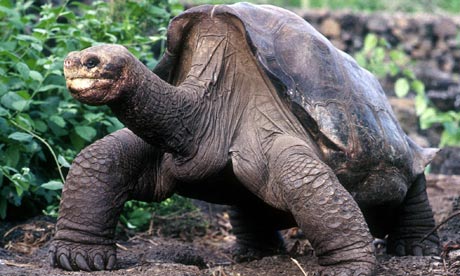
  In the first of my monthly wildlife news stories, which have caught my attention, there really is only one place to start. The sad news has very recently broken that Lonesome George, the last of the Pinata giant tortoises has died aged 100 making the species now officially extinct. Famous for his lack of interest in breeding despite repeated efforts to encourage him to do so, George was discovered by a park ranger on Sunday morning where it became clear his life cycle had run full circle. George was a huge attraction for tourists and became a symbol of the Ecuadorian Galapagos islands, which it was estimated had 180,000 visitors last year. After a post mortem to discover a cause of death, there are possible talks about embalming George's body to display in the Galapagos National Park for future generations to view. Surely a fitting tribute to an iconic and charismatic animal.
Visit the Telegraph online for the full story.


Image taken from http://static.guim.co.uk/sys-images/Guardian/Pix/pictures/2009/7/22/1248256019842/Lonesome-George-001.jpg.

I was recently pleased to read that a young Kenyan herder, Richard Turere, has devised a
possible solution that could well benefit both wildlife and people. By flashing LED lights around his livestock, he has for the past two years successfully deterred Lions from  predating on his cattle and other domesticated animals. Such is the success that he on  a personal level has had  that the idea is now being investigated on a greater scale to see if it has an impact on the number of clashes between people and wildlife. As it seems Lions associate lights around the cattle with activity and people, it would seem that not only do the lights restrict the Lions activity through fear of people, the lights also affect their night vision and so avoid lights whenever possible. There is a fear of Lions becoming habituated to this however with 100 of the country’s 2000 Lions being killed each year in acts of retribution by farmers because of lost live stock. It would seem this new deterrent could well become vital in the long run for both humans and Lions.


Image taken by author


And the third story that grabbed my attention today is a story which allows room for speculation. Costa Rica's Jaguars it has been discovered are rapidly changing prey preference to Green Turtles. Between the years of 2005 and 2010 it has been recorded that Jaguars killed 672 Green Turtles. At present it is unclear why this prey switch has happened.


Source BBC Wildlife July Edition.


                            Available at http://www.sciencephoto.com/image/387627/530wm/Z9340252-Jaguar-SPL.jpg

                            A brief thought from myself.

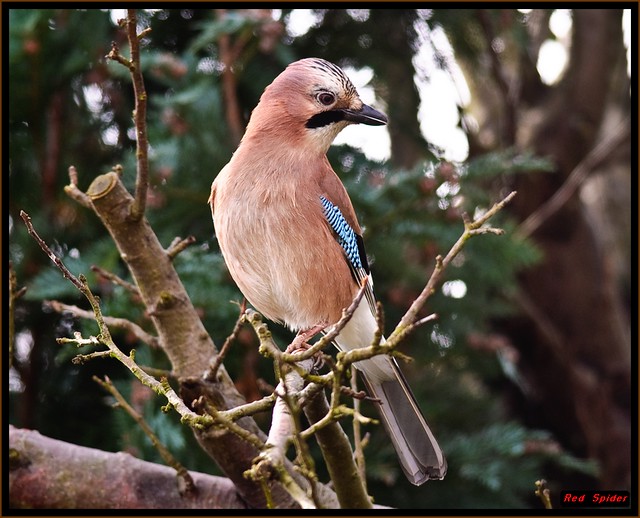
For the first time in a number of years I saw a Jay in the back garden of our home.  It is a strikingly beautiful bird which is becoming an all too rare sight. It really brought a smile to my face as it foraged for an estimated 20 minutes before moving off perhaps in search of a tastier meal. Perhaps a predator I had not seen had come into view, either way it was fantastic to see such a charismatic bird again after such a long absence.


Available at http://farm3.staticflickr.com/2743/4391407857_a09c437046_z.jpg?zz=1.

Bye for now George.

Wednesday, 20 June 2012

You will not see Wild Dogs.

Sitting in a makeshift classroom our guide is smiling almost sympathetically at our optimism. The question has just been asked about the possibility of seeing African Wild Dogs during our time in  the Thanda and Intibane game reserves South Africa. "Yes they are here, but you won't see them" he laughed and deep down I knew he was correct in saying how minimal our chances were of seeing one of the most endangered carnivores on the planet. In fact I had barely allowed the thought of seeing them to cross my mind at all on the eleven-hour plane journey from Heathrow, nor on the following eight hour bus journey from Johannesburg to camp.

 A week of our stay had passed and as expected we had  not seen any Wild Dogs. Not that this concerned us too much if at all, every day in our beautiful surroundings was a privilege. The novelty of walking round camp and startling Warthogs, Wilderbeest and Impala never wore off while cheeky Vervet Monkeys watched on from the trees, only venturing down to risk a raid on the store room should it be left unguarded. The huge abundance of wildlife viewed on game drives including a glimpse of the critically endangered Black Rhino was staggering and it felt like things could not get any better. They could.

 The start of week two signalled the start of our surveying duties. After having  had a week to settle into camp we were assured the hard work would really start now. As our vehicle set off at the crack of dawn it hit us  just how icy cold early mornings in South Africa could be, our breath being taken away as the wind whipped through our vehicle. The journey to the first survey site continued and as the sun started to rise I bent down to take my camera out my bag and then it happened, the excited talking from the group, the usually cool guides as well meant only one thing. Something special had just come into view.

  I quickly grabbed the camera and looked up. I probably had one of the biggest grins my face has ever produced  because right in front of us crossing the road was an African Wild Dog and not just one either. This was the full pack. Their strikingly beautiful colours were the first and most obvious feature that grabbed the attention of the group. A mix of yellows, brown and white it was easy to see why they are otherwise known as the painted dog. Their overall size was not huge, approximately just over a meter in height, and seeing them up close demonstrated their slender, agile bodies perfectly adapted for long distance chases in all their fine detail.

  Their curiosity towards the group in this strange contraption was fascinating to watch. Far from being intimidated, they kept the their distance and observed us allowing us precious extra time to make the most of this incredible experience. Witnessing them at such close quarters also allowed us to observe group behaviour as they trotted away regularly checking to make sure each member of the pack was present. Keeping a strong bond is essential for a pack hunting animal and it was obvious this was clearly an efficient but also highly intelligent pack of animals in front of us.

   Eventually  they caught the scent of an unwary Impala on the wind .Maybe they felt we had seen enough of their world  and they melted back into cover. That experience remains one of the most incredible sights I have been privileged enough to see and  I will be always be grateful for those few minutes spent in the company of these truly remarkable animals.

              Take it easy
               George.